Project Length: 5-7 minutes
For the final week of our course, each of you will present a brief summary of your research to the class. You may choose to summarize the central argument of your paper by reading your thesis and one or two of your close readings of passages. Or, you might decide to read sections of your paper that you most enjoyed writing. The format and content of this presentation are left entirely up to you. But, keep in mind that the point is to generate questions in and between members of your audience. If you have any questions in the meantime, please let me know.
Good luck
Monday, April 16, 2012

Matt Dembicki's Trickster: Tricksters and Gods
In what follows C.W. shares her thoughts on Matt Dembicki's Trickster:
* * * * *
While reading Matt Dembicki's Trickster, I could not help but draw some comparisons between the tricksters of Native American folklore and the heroes of ancient Greek mythology. The most notable stories would be “How the Alligator Got His Brown, Scaly Skin” (123-136) and “When Coyote Decided to Get Married” (149-160), which revolved around collectivist ideas such as sharing your possessions or that one's incompetence leads to the downfall of the entire group. Both stories involve morals that are precedent in Greek myths, namely the concepts of hospitality and deceit. When reading “Alligator,” the first thing that came to my mind was xenos, which can mean anything from “foreigner” to “guest” to “friend,” depending on the context and how it is used. Ancient Greek society stressed upon the ideas of hospitality, and if one was inhospitable to a guest, they could count on Zeus, considered the God of xenos, to punish them. In the story of “How the Alligator Got His Brown, Scaly Skin,” Alligator gets burned by burning wood when he does not let other animals drink from his pond. Since the pond is technically his home (that is where alligators live after all), he's not being a very good host. Similarly, when Odysseus and his crew mates arrive at the cave of Polyphemus, a cyclops, Polyphemus reacts by eating a few of Odysseus's men—not exactly a hospitable act. Odysseus gets revenge by blinding Polyphemus with a hot spear of wood. Both stories show instances of characters not being hospitable to their xenoi, or guests. They can also be seen as a warning to not be selfish with your own possessions. Since many Native American tribes are collectivist societies, this makes sense. (Collectivist societies stress the importance of putting the
collective group above oneself.) Clearly, as a group-oriented people, Native Americans must learn to share their resources. Thus, stories about unfriendly hosts such as Alligator and Polyphemus could be seen as showcases of what happens when you try to stray away from collectivism (or in Greece's case, hospitality). (Although since ancient Greece was actually an individualistic society, the fact that their culture was so “guest”-based is surprising.)
“When Coyote Decided to Get Married” also depicts an interesting moral. When a family presents their daughter to Coyote, he is furious that they brought an “unpure” woman to him. Even though the family had no idea their daughter lied about being a virgin, Coyote punishes her family and all of the other families that were waiting on him by turning them into stone pillars. The daughter's deceit leads to everyone being punished. The Greeks have a similar moral, where one person's lie leads to the punishment of the whole group. In one Greek myth, a man named Tantalus attempts to deceive the Gods by serving them his son, Pelops. The Gods quickly realize this deceit and Tantalus is punished for his terrible deed. However, it does not end there. There are three big taboos one should never commit in ancient Greek society (or any society, for that matter). One of which, happens to be infanticide. Anyone who commits a taboo will be cursed. Thus, Tantalus and all of Tantalus's descendents end up dying terrible or dishonorable deaths (usually by murder). Tantalus's children had nothing to do with the death of Pelops, but they were cursed anyway. Similarly, in “How the Alligator Got His Brown, Scaly Skin” the other families had no part in that one woman's deceit, yet everyone was turned into stone. This could thus be seen as a moral supporting a collectivist society, teaching that one's deceit leads to the downfall of the entire group.
Although anyone can point to a story and compare it to another, the similarities between Native Americans and Greeks do not just end with folklore and mythology. Although ancient Greece was considered an individualistic society, with its emphasis on heroic deeds and the importance of a single individual, its beliefs were also highly collectivist. Both Native Americans and ancient Greeks believed in the importance of the group, namely with the ideas of xenos and collective punishment.
Sunday, April 8, 2012
Matt Dembicki's Trickster: The Interconnectivity of Life

In what follows S.X. shares her thoughts on Matt Dembicki's Trickster: Native American Tales a Graphic Collection.
* * * * *
“Human kind has not woven the web of life. We are but one thread within it. Whatever we do to the web, we do to ourselves.All things are bound together. All things connect.” Chief Seattle's words ring true as Native American culture embraces the interconnectedness in nature between animals and humans alike. This close relationship with nature is shown through their stories, especially the trickster tales, as many types of interactions between different species in the web of life occur. The bond within the cycle of life is so strong in trickster tales, that not only do different animals interact with each other, but there is actually a fusion between animals and humans present in the form of shapes shifters and half humans. The interwoven connection transgresses beyond physical boarders to the point that animals are able to adopt humanistic characteristics. In a graphic interpretation and illustration of trickster tales, Trickster by Matt Dembicki shows the interconnectedness in nature of different beings through anthropomorphism and transcending the boarders that separate different species
Anthropomorphism is a common occurrence in trickster tales, and many of these animals and humans have certain characteristic that parallels a archetype. An archetype is a terminology coined by Carl Jung that states that there is a instinctive need or desire to have things happen in a certain way (Boeree). The idea of archetypes is important in trickster tales and it is usually reflects a human trait. For example, in the story “How the alligator got his brown, scaly, skin” by Joyce Bear and Megan Baehr, the alligator, “was very selfish and stingy with his water. He always claimed every bit of the river as his. From up the hill, Alligator could see up and down the river and scare the other animals away” (126-127, Dembicki). Alligator's selfishness and greed is an archetype, here he feels the instinctive need to dominate the water. This dominant behavior is something that alligator has inherently, and therefore is a subconscious desire that he has. In this story alligator's selfishness mirrors human archetypes in which he wants to dominate and posses something that does not belong to him. Land and water are things that are supposed to be shared resources, but alligator is making a claim to a piece of land where many other organisms live and need to utilize this land. This is a parallel to worst of human nature and our need to own something and take it for ourselves for our own selfish purposes. This story serves almost as a warning to the white settlers that colonized the Americas when the Native Americans were here. The idea of being selfish and taking more than you need represents the mindset of the white settlers at that time who claimed the land to be their own rather than see it as a shared resource like the Native Americans had. Eventually the selfishness of alligator led to his downfall because he failed to be interconnected to the other animals and thus nature around him by wanting to dominate rather than coexist with nature. Similarly this can be seen as a human trait where selfish and needless desire to dominate nature can lead to disastrous results to anyone who tries. The anthropomorphic characteristics of the alligator are used to display the similarities and interrelatedness between human and nature, showing that humans and nature are not necessarily that different. This story between animals is used to teach a moral that can be applied to humanity as well, reinforcing the idea that there exists an interconnection between humans, animals, and nature as a whole.
The idea of transcending boarders or rather the ambiguity of boarders and separation between humans and animals provides another very provocative topic in the trickster tales. While anthropomorphism is a similarity in traits, tricksters are also physically similar to humans either presented through the power to shape shift or their appearance has traces of animalistic features to them. Inter species communication and relationships are regarded as normal in trickster tales, even though normally nature does not coexist this way. This synchronization of nature and man shows a united world where animals and humans do not differ very much between each other. For example, in the story “Trickster and the Great Chief” by David Smith, the unnamed trickster is a blend of human and animal characteristics. His hands and legs are furred and clawed like that of an animal and his malicious intentions to steal look very predatory like that of a feral animal. His primitive and ferocious outer appearance reflects his inner self as a human with malice in his heart trying to thief and prey on the helpless. The lack of separation between human and animal reiterate the close relationship between man and nature where man is a part of nature and the world around him.
Interspecies relationships are also very prominent in showing the unity of humans and nature. For example in the story “When Coyote Decided to get Married” by Eirik Thorsbard, the coyote asks the chief to, “send runners on my behalf and bring me a bride” (152, Dembicki). Even though the coyote is an animal, he asks for a human bride and the chief readily agrees to this request. Not only that but, “Many women and their families came from around the lands to go to coyote, each bringing gifts to present to him, hoping that it would ensure that coyote could give their families consideration for the marriage” (158, Dembicki). The willingness of the people to marry their daughters off and accept a coyote as part of their family shows the lack of separation between species, or rather an interconnectedness between species. The fact that coyote and his bride will be nothing alike physically does not seem to deter these women and families from coming to visit him. The casual relationship between humans and nature where humans are able to directly communicate with nature supports the idea that all life is interconnected and that the boundaries between human and animal should be few, if any.
The theme of unity with nature is a central idea that much Native American culture is based off of, and the trickster tales help preserve and reiterate this interconnectivity. By incorporating animals and humans into one central story, the Native Americans are able to be part of the cycle of life as nature intended it.
S.X.
Sunday, April 1, 2012
Ishi: The Last of the Yahi: Stories as Greater than Life

In what follows L.C. reviews Ishi: The Last of the Yahi.
**Please note: My quotes of the play may not be entirely verbatim.
The great majority of the play, Ishi: The Last of the Yahi, is based upon Dr. Kroeber's obsession with wanting to make a display out of Ishi's stories. Ishi's stories takes on three prevalent themes throughout the play - stories as a cycle of life, the translation of stories, and the sacredness of the stories. Dr. Waterman begins to be able to predict Ishi's stories after awhile, because he realizes that "each of his stories balances out", much like cycles do - all points in the most Native American life is equally important, no point is more significant than the next. The translation of Ishi's stories were done both by Thaddeus - a half-Native American who was quickly disposed of once Ishi was found - and Dr. Waterman, but the entirety of the play seemed to play on the idea of translation - it was often ambiguous at times whether Ishi was speaking for himself or through another character. Lastly, the sacredness of stories seemed to be greater than life, as Ishi admitted that "once I knew my sister was dead, I came out of the forest to be killed, but instead, this", referring to the prying of Dr. Kroeber or Ishi's stories. Ishi once had a past of being told never to tell anything to anyone because "it is dangerous" to do so, but yet he is given virtually no choice by the power-hungry Dr. Kroeber.
The heaviest part of the play was during the killing of Ishi and his sister's incestuous child. I found myself thinking, "What in the world could possibly be so horrible as to trigger a killing of one's own child?" Yet, as it turns out, the disobedience of tribal tradition - the forbiddance of marrying one's own family member - overruled any rationality of love for one's own child. But the action of Ishi muffling a crying child wasn't the only action in the play - it didn't stand alone, but rather, recurred two other times. When Dr. Kroeber takes Ishi home to his house as way to "surprise" his guests at a house party, or rather, treating Ishi as this prized possession of his, another cycle appears - the recalling of Ishi's traumatic experience with white men's dogs helping to hunt down and destroy Ishi's own father. Ishi's experiences are his stories that Dr. Kroeber wishes to pry out of Ishi, regardless of whether or not it meant draining Ishi's life right out of him. The particular story of Ishi suffocating his and his sister's incestuous child was a literal draining of a physical life, but also had a powerful impact on Ishi's spiritual life - that one story "by the river" triggered a flood of other stories that inundated Dr. Kroeber with more information than he ever needed to or expected to know. Perhaps Dr. Kroeber never knew much about how Ishi treated Henrietta, but that, too was part of the cycle. Seeing Henrietta cry triggered a degree of compassion of in Ishi, who didn't know much else to do than to muffle her to keep others from thinking he was attempting any sexual or violent advances. His silencing of Henrietta parallels to his silencing of both his child's crying and later on, his sister's child's crying. After Ishi's physical silencing of him and his sister's child, his sister's leaves him in anger, filled with hatred. Later, she returns with a mixed child and asks Ishi to do the impossible - killing yet another child so she can continue her relations with a white man, who later on plots with others to kill her. Ishi is both distraught by his sister's betrayal and his sister's death, caught, trapped, without knowing what to do. He knew that white men did no
good - the cycle of gunfire and violence triggered continuously throughout the play by the witness of Native American skulls, the barking of dogs, and by recalling his sister's death - killing his father and destroying his family. Finally, after his sister's death, he feels no duty to live anymore, and comes to die, hoping to be freed from the stories of his past, only to be drained of it by the very source that destroyed his physical family. Ishi himself also triggers cycles throughout the play, by almost forcing other people to tell their own 'deep' life stories in order to press his stories out of him, complicating the plot further.
At the party Dr. Kroeber throws, Henrietta reveals her obsession with Dr. Waterman while Henrietta's friend (name I can't remember) reveals her affairs with the same man - all in front of both Dr. Kroeber and Dr. Waterman. The play essentially follows the stories of two family's - Ishi's and Dr. Kroeber's. The translation of Ishi's stories is assumed to be done through Dr. Waterman who clearly sees that the white's treatment of Native Americans was a genocide of its own, and warns Dr. Kroeber to be careful of prying anymore out of Ishi. Of course, Dr. Kroeber can't help himself and pries further, but each time Ishi tells his story, Ishi speaks for himself, rather than through another individual. Yet Dr. Kroeber, during common-day interaction with Ishi, reveals that he "can't understand what [Ishi]'s saying" while he seems
to be overwhelmed by the depth to Ishi's life told in common-day language. Thaddeus's presence in the beginning also suggests that the stories may not be accurate at all, depending on the mood or bias of the translator - in Thaddeus's case, he was bitter and resentful because he had just been replaced by this mysterious Ishi. Early on in the play, Thaddeus pried something loose from Ishi as a way to seek revenge upon Dr. Kroeber. In general, the fact that makes the play so ambiguous is whether or not Ishi was truly speaking for himself - we don't know, as audience members, whether or not Ishi's stories are to be taken as a whole-hearted fact. Because of history and the stereotype of Native Americans as brutal savages, Ishi's stories may actually depict the violence accurately. The audience, too, will have a tendency to sympathize with Ishi because of the brutalities forced against him - but may also experience a skepticism to completely sympathizing with Ishi, because of his lust for his sister and his contribution to the death of two babies. The translation of the story may also be ambiguous because of Ishi himself - after all, he may still suffer from post traumatic stress disorder, causing him to tell his stories as more violent and intense than they may actually be. Ishi may also be bitter at Dr. Kroeber and the team for forcing him to tell the stories in the first place, which may drive him to sugar-coat the stories, diminishing the intensity and pain, or may drive him to increase the intensity to purposefully inundate his listeners. And the other possibility of translation may just be the issue with translation itself - often times, translations will never truly be able to capture the essence of the real story, because languages don't always transfer cleaning to another. In general, this paragraph is meant to question the overall validity of the play through the lenses of translation of the stories - the other point that I wish to make
here is to ask whether or not the stories were ever meant to be translated in the first place. Can the American language ever do justice to the American Native American languages? Can the stories ever be rightfully translated and given the place they deserve in history? I personally thought that the play purposefully made it difficult to completely sympathize with one side or the other by making the translations ambiguous, but is that tactic ok? Or do the Native Americans like Ishi deserve a reckoning? And to complicate the matters further, if the stories of Native Americans like Ishi are to remain untold as to preserve a sanctity of tradition, how else is the general public supposed to know what things are like from the Native American perspective? Is there another tactic?
And finally, these questions resolve to the sacredness of stories itself in the Native American tradition. My first blog entry was commenting on the power of stories to create an individual and a community. [From my previous blog entry: The introduction of Reckonings (the book) reads, "Even if read in isolation, the stories create community", because that is often times how Native Americans were able to keep their traditions, heritage, and most importantly, their identities alive.] Ishi was in complete isolation when he emerged from the forest to be killed - but what he had was his stories that he perhaps wished to keep until his death. His stories were all that he had to hold onto, whether good or bad. Yet, rather than taking his physical life, Ishi was drained by Dr. Kroeber's hunger. By exposing all that Ishi had, Ishi himself had subjected himself to the judgment and power of whites, the very race that had taken away his physical family and community. And this robbing of stories only returns me back to the questions I posed in the previous paragraph: Is there another way?
Riding the Trail of Tears: Compassion and Altruism

In what follows A.S. examines Blake Hausman's novel Riding the Trail of Tears.
* * * * *
Under normal circumstances, we are generally compassionate and giving. We act in the best interests of others--we are caring and we empathize with members of our community. In a sense, we act irrationally and against human nature. However, when we are taken out of our comfort zone and placed in a situation that is dangerous and unpredictable, we act on impulse and our innate, sometimes selfish, human instincts. Political philosopher Thomas Hobbes once said, “The life of man is solitary, poor, nasty, brutish, and short. The condition of man is a condition of war of everyone against everyone” (Leviathan). According to Hobbes, man in the state of nature seeks nothing but his own selfish pleasure. It is human nature to place oneself above others. Being taken out of our comfort zone tests our personality and questions everything we know about ourselves--or thought we knew. In Riding the Trail of Tears, I believe Blake Hausman made it a point to show that people have their true animalistic nature come out on The Trail of Tears and, that at times, this can be inherently selfish (or “rational”).
Danny wishes selfishly to fulfill his animalistic desires regardless of the consequences. For example, Danny is found with his, “body rolling limply over puddles of blood and clay, poked and prodded by soldiersʼ bayonets” (Hausman 226). Apparently, Danny had grabbed a woman with the intention of raping her. As a young male with raging hormones, he could not resist the sight of dozens of semi-naked Cherokee women. Danny’s motivation for the rape was purely animalistic in nature. Danny knew there would be consequences for his actions; however, the intention of rape was still there. Danny did not care for the emotional pain it would cause Mandy, his girlfriend, if she found out about his reckless actions. In the moment, he did not care about their relationship. He placed himself above Mandy because his animalistic urge for sex was too large to ignore. This animalistic urge for sex proves to be a stronger force than his conscience. Dannyʼs inherently selfish animalistic urge for sex ultimately resulted in his death.
There is another case of selfishness in the rape scene involving Danny. As this scene is told through Tallulah, we do not read about the actual rape. When first learning of the rape Tallulah hears, “Gunshots ring...she hears Spencer calling her name. Yelling her name. Screaming.” You may think the rape is Danny’s fault alone. However, before Danny’s rape of the Cherokee woman, Tallulah had noticed “the bulge in Danny’ pants.” Tallulah could have prevented the rape if she had warned Danny about the consequences. However, Tallulah chose to ignore Danny’s erection because she was preoccupied with talking to Wallace about Irma Rosenberg. Tallulah selfishly prioritizes finding the missing Irma Rosenberg to preserve her survival statistics. This leads into the discussion on Tullalah and her state of mind as a result of the Trail of Tears.
Tallulah admits she has lost her sense of empathy upon riding the trail of tears. For example, in response to the lack of empathy she feels towards Mandyʼs beating, she says, “Why do I feel so little for these dead and dying tourists? Of course itʼs all a simulation, but something is missing, and itʼs terrifying. She begins to wonder if itʼs more than just her need for a vacation. She wonders if she is becoming less human” (Hausman 266). After one is exposed to gut-wrenching events such as murder, torture, and rape, one is left feeling desensitized. It is a sense of empathy that separates humans from animals and this is what Tallulah feels is “missing”. Unfortunately, riding the trail of tears dehumanizes Tullulah, leaving Tellulah stripped of that which makes her human. When Spencer attempts to help Mandy, Tallulah responds with alarming ease, “Just keep moving.” Although this is the correct response as a tour guide in her situation, one cannot help but think how Tallulah would respond to a similar real-life situation. Would she be able to tell the others to “keep moving” with the same ease and bluntness? Tallulah admits she feels nothing, and it is clearly affecting her state of mind.
Tallulah’s motivation to preserve her survival statistics remains ambiguous. Her motivation may be out of compassion. For example, she may want to give her customers the best experience possible. This means that sacrifices are necessary to preserve the interests of the group as a whole--correlating with the Native American culture of “communal interest”. Her motivation may also be attributed to selfishness. She may want to be the best tour guide for professional gain. At the very least, this would give her job stability and decent pay. In addition, since this is a virtual simulation, is it fair to claim she has lost her sense of empathy?
In my opinion, the ease with which Bob Rosenberg falls asleep is the most convincing case demonstrating the inherent selfishness of man outside his comfort zone. For example, Bob Rosenbergʼs wife is missing and he is, “passed out and stuffed, convinced that his limber old body is full and tired, so physically content that he can nap in a chair facing a strange fireplace even though his wife is missing” (Hausman 138). Clearly, Bob Rosenberg has no concern for his wife. He seems to have forgotten her. His thoughts dwell on his physical discomfort from the journey. His motivation to forget about his wife is to gain physical comfort, a disturbing thought in nature. In our society (outside the “state of nature”), love is sacred and we have high regard for it. We respect the institution of marriage and the inherent worth of love as a form of unselfish expression. Unfortunately, this was not the case as Bob Rosenbergʼs animalistic desires were placed over his wife’s interests.
A hard case for my argument is that of Nell Johnson’s. For example, Nell Johnson believed her children were hungry and despite warnings such as, “Lady--either stop right now, or Iʼll shoot yer dumb ass dead,” (Hausman 186) she sprinted in order to retrieve fruit for her children. If Blake wants to show that human nature is inherently selfish, then why did Nell Johnson (selflessly) put the needs of her children above her own safety? Firstly, we are unsure as to whether Nell Johnson’s motivation was to retrieve food for her children or escape from captivity. However, I am going to assume she was planning to retrieve food for her children. Nell Johnsonʼs selflessness does not actually contradict the theme of man’s inherent selfishness. The natural instincts of a mother to care for her children can also be contextualized as “selfish” if we think about rationality more generally as picking those actions which gives us the highest utility. The sight of her children suffering for food causes her pain--to minimize this pain and maximize her utility (thus, acting “selfishly), she puts their physical needs over her own. This gives her greater pleasure and, therefore, might be classified as not entirely “selfless.”
I think there is a level of irony in the intended purpose of the TREPP. Going as a tour group was supposed to show the Native American culture of communal interest; however, these characters acted in their own self-interest on multiple occasions. In Native American society, straying from this idea of communal interest is shunned. In a sense, it is fitting that these characters were punished on The Trail of Tears for their actions in the TREPP.
A.S.
Monday, March 19, 2012
Riding the Trail of Tears: Exploitation of Suffering
In what follows C.C. examines Blake Hausman's novel Riding the Trail of Tears.
* * * * *
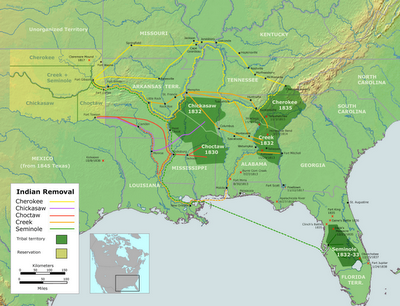
An important topic addressed in Blake Hausman’s book Riding the Trail of Tears is the exploitation of suffering for commercial gain. The story takes place in a futuristic setting where the infamous Trail of Tears has been recreated as a virtual reality tourist attraction. Located in the Tsalagi Removal Exodus Point Park in Georgia, this virtual trail leads tourists on their own personal Trail of Tears so that they may experience the same sufferings Native Americans did back in 1838. The story follows Tallulah Wilson, a part Cherokee tour guide for TREPP, as she takes tour group 5709 on what is supposed to be a normal trip through the virtual Trail of Tears. However, the unexpected presence of Nunnehi from Native American legends in the virtual trail causes the ride to veer off into an unpredictable adventure. Hausman uses this idea of the virtual trail to criticize universal exploitation and trivialization of suffering for commercial gain.
Rather than create the TREPP as an accurate way for people to experience the authentic suffering of Native Americans, the ride is more catered to making the customers happy so that they will be willing to spend their money on the ride again. One example of this exploitation can be seen when Tour Group 5709 first enters the ride and notices that their genitals have increased in size. Hausman describes the motivation for this by writing, “It’s true. Everyone’s breasts and penises are slightly larger on the Trail of Tears. Anything to ensure customer satisfaction, regardless of historical inaccuracy, and body parts are always a welcome distraction for the average customer” (93). This quote shows that the TREPP’s main priority is customer satisfaction rather than historical accuracy. Instead of focusing on Native American history, the owners are more concerned with making money from this experience.
Hausman also uses the Misfits as a metaphor for how the TREPP is trivializing the suffering of past Native Americans as a way to make profit. This can be seen in Irma Rosenberg’s conversation with the Misfits. After entering the Trail of Tears, Irma is separated from tour group 5709 when she exits the first cabin and somehow ends up in the Misfit stockade. After meeting the Misfits there, she begins to learn a little bit about them, despite their elusiveness in answering her questions. When Irma asks the Misfits why they can’t just leave, they tell her, “We are targets. We were programmed to be killed, then brought back to life…We always begin again after we die…just to be killed again” (119-120).
This shows how the suffering of Native Americans on the Trail of Tears has been trivialized, as their suffering has simply become a recurring event in a typical theme park attraction, like some kind of haunted house. Hausman voices his opinion on this exploitation of Native American suffering through Irma, when she says “That’s just terrible…That’s worse than being dead. That’s worse than life in death” (120).
This trivialization of an important event in Native American history can also be seen in Tallulah Wilson’s journey through the virtual Trail of Tears. The soldiers who capture Tour Group 5709 are described as “unflattering caricatures who spit and grunt. They are archetypal antagonists” (177). Once again, historical accuracy is ignored on the ride in order to provide the customers with what they believe they should be seeing. This happens again during the death of Corn Grinder. During her death scene, Hausman writes, “Now, if the scene were truly authentic, she would scream in Cherokee. But translation is critical to customer satisfaction in such pivotal moments of the Removal, so Corn Grinder screams in English” (177-178). This shows how the creators of the virtual Trail of Tears have no reluctance in changing history to suit their customer’s needs.
Hausman also uses Tallulah’s personal reactions and feelings on the Trail of Tears to demonstrate how the TREPP has trivialized the sufferings of Native Americans. Tallulah has ridden the virtual Trail of Tears so many times that she has become essentially desensitized to the brutal violence inflicted upon these virtual representations of her ancestors. She is no longer affected in any way by the sufferings of these virtual Native Americans, as it has become something she sees every day. For example during Corn Grinder’s death scene, Hausman writes, “Tallulah, naturally, is unphased by the death of Corn Grinder” (178).
This is seen again in Tallulah’s indifferent attitude during Danny’s death scene in the stockade, which demonstrates how accustomed Tallulah has become to this violence. Tallulah is not even surprised, as Hausman writes, “Tallulah doesn’t need to ask Mandy for any further details. She’s seen it all before” (226). Tallulah even goes so far to tell Mandy “Relax…It’s just a game” (226). This demonstrates how the TREPP’s transforming of the Trail of Tears into a tourist attraction for commercial gain has completely trivialized the experience of Native Americans. In this way, people who ride the virtual Trail of Tears multiple times eventually become apathetic to the sufferings of Native Americans in the past and think of it as “just a game.”
This idea of trivializing the Trail of Tears by turning it into a tourist attraction for commercial gain is a major theme throughout Hausman’s story. His criticism appears to target anyone who exploits a group of people’s suffering as a way to make money. However, whether Hausman feels this way about similar tourist attractions, such as Nazi concentration camps and other such locations, is uncertain.
C.C.
Thursday, March 15, 2012
Riding the Trail of Tears: Naming and Native America
 In what follows Y.L. shares some initial thoughts on Blake Hausman's novel Riding the Trail of Tears.
* * * * *
I really enjoy reading the book Riding the Trail of Tears, and taking a virtual ride on the Trail of Tears, because the book engages me in an interesting story and provides me a good insight of the real history of the Trail of Tears in a completely new way. The author, Blake M. Hausman, incorporates the elements of futurism and surrealism into the story, we can imagine that maybe several years later, the digital ride of The Trail of Tears might be achieved, as people are immersed in the clash of technology, electricity, digitalis, and Internet in the daily life. The story seems virtual, but do lead you into a real bloody history of Indian removal.
As the story takes place in virtual-reality, we enter a machine that takes us to 1838 and gives us a chance to experience the Trail of Tears the way it happened then, only digitally. It is an adventurous ride, made even more stimulating by technical problems and by the sudden appearance of Nunnehi people. In addition, we are also presented with the protagonist Tallulah Wilson's personal struggle, the reoccurring strange dreams, her love and anger for her dead father, and whether feel offended by the Jeep Cherokee.
The whole story is told by two main trip lines: Irma Rosenberg’s encountering with a bunch of programmed Native people, and the rest of the group 5097’s trip. At the beginning of the virtual trip, as grandma Irma Rosenberg straps into the Chairsuit, she steps into another room-from inside of the First Cabin to the inside of a roofless log compound, where she meets approximately a thousand Native people who don’t even own their names. The fact that these Native people don’t have names provokes Irma’s curiosity, since she thinks that it may be a barrier for people to communicate with each other. Irma distinguishes people by appearance. However, as the Giant Hat said “One cannot be a target if one has no name,” as well as Indians Hat said “Someone can be conquered by our enemies, but once you have become no one, they can no longer conquer you.”(118) Why would the Natives discard their name ?
Name is a significant symbol and identity of individuals living in the society, and makes people’s existence in this world meaningful. In order to survive, the Natives that Irma meets would rather choose to abandon value, dignity, and even the right to own a name, though reluctantly. A tone of sadness and blueness flows from the description of these Natives, as Indians Hat said, “We‘re targets. We were programmed to be killed, then brought back to life.”(119) “We always begin again after we die, just to be killed again.” This implies that as a whole notion of American Indian, their fates are totally controlled by others, no matter in the game or in the real world. These people are highly marginalized as their mission is to die in different round of the virtual game, at the same time, in order to fit white people’s desire of occupying North Carolina, American Indians were kicked off from their homeland. They had names before, but their names are getting dangerous to them as they were exposed to the whites’ empowerment. I wonder what experience makes American Indian people non-named? Just as Irma thought “That’s worse than life in death,” the Trail of Tears must be even worse and cruel than what I thought. It’s a bullied-to-death.
In terms of name, the book not only talks about name itself, but also the meaning it reflects. The discussion about Jeep Cherokee were provokes by Spencer, one of the group member, who is a college student. Spencer, with a sudden realization, asked whether American Indians are offended by the Jeep Cherokee. It seems that “Cherokee” hasn’t drawn much attention to people before. Well, it’s hard to tell whether the name cross the line of culture or religion, but it is controversial and not ignorant. This group of tourists is further listing names like “Ford Semite”, “Hummer Hassid”, “Chevy Mexican”, “Chevy Jew”, “Mercury Mullah”, and “Plymouth Puritan”, while they are laughing and entertaining about all these weird names (145). It may seem that among all of the “religion”-related car names, Jeep Cherokee is not especially offensive. However, in each society, only Cherokee is struggling to get rid of marginalization. Mullah, Mexican, Puritan are all existing as a mainstream culture in different society, so none of them will be used for car name.
A name sometimes works as a symbol that is related to spiritual sustenance. When Irma asked where to go to all the Natives she met, they advocated North Carolina. Yankees Hat noted that “It’s beautiful there” without ever been to there. Irma wondered “How do you know how nice it is if you’ve never been there yourselves?” “We know,” answered Indians Hats. “We all know.” Irma said “You know, Tallulah Wilson called it the motherland too. She called it the motherland, she absolutely did.”(124) These natives were told to forget their own names, but they do remember and long for their motherland----North Carolina. North Carolina, not only a name, but a heaven, an expectation, and a homeland, symbolizes hope, which is more crucial than their names. This part is also an implication of the result of the tragic Trail of Tears:The Natives are living in the imagination of their motherland.
The story include the narrator’s personal experience on the studying the Trail of Tears. The narrator complains about the insufficient evidence that she could find regarding the events and facts. The narrator, Tallulah, concluded that the Trail was intentionally undocumented and that the quotations were anonymously concocted post-Removal by writers who melded shards of memory in the fires of nostalgia (173). The fact that the material for such a big historical event is inadequate makes me feel sympathetic for the Cherokee and whole American Indian people. Their names should be engraved into the human history, and their miserable experience should be documented specifically in the historical reference even in the Anglo-dominant society for the reason of respecting history. Nonetheless, the real situation depresses us.
In my perspective, the TREEP program of digital ride in the story gives people a warning: Don’t forget the tragedy of The Trails of Tears that Native Americans suffered. What we should do is to give them names, give them credits for the miserable episode in human history, and give their culture living space in American.
Y.L
Subscribe to:
Posts (Atom)