Monday, March 19, 2012

Riding the Trail of Tears: Exploitation of Suffering


In what follows C.C. examines Blake Hausman's novel Riding the Trail of Tears.
* * * * *
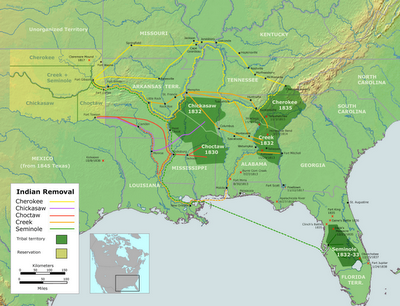
An important topic addressed in Blake Hausman’s book Riding the Trail of Tears is the exploitation of suffering for commercial gain. The story takes place in a futuristic setting where the infamous Trail of Tears has been recreated as a virtual reality tourist attraction. Located in the Tsalagi Removal Exodus Point Park in Georgia, this virtual trail leads tourists on their own personal Trail of Tears so that they may experience the same sufferings Native Americans did back in 1838. The story follows Tallulah Wilson, a part Cherokee tour guide for TREPP, as she takes tour group 5709 on what is supposed to be a normal trip through the virtual Trail of Tears. However, the unexpected presence of Nunnehi from Native American legends in the virtual trail causes the ride to veer off into an unpredictable adventure. Hausman uses this idea of the virtual trail to criticize universal exploitation and trivialization of suffering for commercial gain.

Rather than create the TREPP as an accurate way for people to experience the authentic suffering of Native Americans, the ride is more catered to making the customers happy so that they will be willing to spend their money on the ride again. One example of this exploitation can be seen when Tour Group 5709 first enters the ride and notices that their genitals have increased in size. Hausman describes the motivation for this by writing, “It’s true. Everyone’s breasts and penises are slightly larger on the Trail of Tears. Anything to ensure customer satisfaction, regardless of historical inaccuracy, and body parts are always a welcome distraction for the average customer” (93). This quote shows that the TREPP’s main priority is customer satisfaction rather than historical accuracy. Instead of focusing on Native American history, the owners are more concerned with making money from this experience.

Hausman also uses the Misfits as a metaphor for how the TREPP is trivializing the suffering of past Native Americans as a way to make profit. This can be seen in Irma Rosenberg’s conversation with the Misfits. After entering the Trail of Tears, Irma is separated from tour group 5709 when she exits the first cabin and somehow ends up in the Misfit stockade. After meeting the Misfits there, she begins to learn a little bit about them, despite their elusiveness in answering her questions. When Irma asks the Misfits why they can’t just leave, they tell her, “We are targets. We were programmed to be killed, then brought back to life…We always begin again after we die…just to be killed again” (119-120).
This shows how the suffering of Native Americans on the Trail of Tears has been trivialized, as their suffering has simply become a recurring event in a typical theme park attraction, like some kind of haunted house. Hausman voices his opinion on this exploitation of Native American suffering through Irma, when she says “That’s just terrible…That’s worse than being dead. That’s worse than life in death” (120).

This trivialization of an important event in Native American history can also be seen in Tallulah Wilson’s journey through the virtual Trail of Tears. The soldiers who capture Tour Group 5709 are described as “unflattering caricatures who spit and grunt. They are archetypal antagonists” (177). Once again, historical accuracy is ignored on the ride in order to provide the customers with what they believe they should be seeing. This happens again during the death of Corn Grinder. During her death scene, Hausman writes, “Now, if the scene were truly authentic, she would scream in Cherokee. But translation is critical to customer satisfaction in such pivotal moments of the Removal, so Corn Grinder screams in English” (177-178). This shows how the creators of the virtual Trail of Tears have no reluctance in changing history to suit their customer’s needs.
Hausman also uses Tallulah’s personal reactions and feelings on the Trail of Tears to demonstrate how the TREPP has trivialized the sufferings of Native Americans. Tallulah has ridden the virtual Trail of Tears so many times that she has become essentially desensitized to the brutal violence inflicted upon these virtual representations of her ancestors. She is no longer affected in any way by the sufferings of these virtual Native Americans, as it has become something she sees every day. For example during Corn Grinder’s death scene, Hausman writes, “Tallulah, naturally, is unphased by the death of Corn Grinder” (178).

This is seen again in Tallulah’s indifferent attitude during Danny’s death scene in the stockade, which demonstrates how accustomed Tallulah has become to this violence. Tallulah is not even surprised, as Hausman writes, “Tallulah doesn’t need to ask Mandy for any further details. She’s seen it all before” (226). Tallulah even goes so far to tell Mandy “Relax…It’s just a game” (226). This demonstrates how the TREPP’s transforming of the Trail of Tears into a tourist attraction for commercial gain has completely trivialized the experience of Native Americans. In this way, people who ride the virtual Trail of Tears multiple times eventually become apathetic to the sufferings of Native Americans in the past and think of it as “just a game.”

This idea of trivializing the Trail of Tears by turning it into a tourist attraction for commercial gain is a major theme throughout Hausman’s story. His criticism appears to target anyone who exploits a group of people’s suffering as a way to make money. However, whether Hausman feels this way about similar tourist attractions, such as Nazi concentration camps and other such locations, is uncertain.

C.C.

Thursday, March 15, 2012

Riding the Trail of Tears: Naming and Native America

In what follows Y.L. shares some initial thoughts on Blake Hausman's novel Riding the Trail of Tears.

* * * * *

I really enjoy reading the book Riding the Trail of Tears, and taking a virtual ride on the Trail of Tears, because the book engages me in an interesting story and provides me a good insight of the real history of the Trail of Tears in a completely new way. The author, Blake M. Hausman, incorporates the elements of futurism and surrealism into the story, we can imagine that maybe several years later, the digital ride of The Trail of Tears might be achieved, as people are immersed in the clash of technology, electricity, digitalis, and Internet in the daily life. The story seems virtual, but do lead you into a real bloody history of Indian removal.

As the story takes place in virtual-reality, we enter a machine that takes us to 1838 and gives us a chance to experience the Trail of Tears the way it happened then, only digitally. It is an adventurous ride, made even more stimulating by technical problems and by the sudden appearance of Nunnehi people. In addition, we are also presented with the protagonist Tallulah Wilson's personal struggle, the reoccurring strange dreams, her love and anger for her dead father, and whether feel offended by the Jeep Cherokee.

The whole story is told by two main trip lines: Irma Rosenberg’s encountering with a bunch of programmed Native people, and the rest of the group 5097’s trip. At the beginning of the virtual trip, as grandma Irma Rosenberg straps into the Chairsuit, she steps into another room-from inside of the First Cabin to the inside of a roofless log compound, where she meets approximately a thousand Native people who don’t even own their names. The fact that these Native people don’t have names provokes Irma’s curiosity, since she thinks that it may be a barrier for people to communicate with each other. Irma distinguishes people by appearance. However, as the Giant Hat said “One cannot be a target if one has no name,” as well as Indians Hat said “Someone can be conquered by our enemies, but once you have become no one, they can no longer conquer you.”(118) Why would the Natives discard their name ?

Name is a significant symbol and identity of individuals living in the society, and makes people’s existence in this world meaningful. In order to survive, the Natives that Irma meets would rather choose to abandon value, dignity, and even the right to own a name, though reluctantly. A tone of sadness and blueness flows from the description of these Natives, as Indians Hat said, “We‘re targets. We were programmed to be killed, then brought back to life.”(119) “We always begin again after we die, just to be killed again.” This implies that as a whole notion of American Indian, their fates are totally controlled by others, no matter in the game or in the real world. These people are highly marginalized as their mission is to die in different round of the virtual game, at the same time, in order to fit white people’s desire of occupying North Carolina, American Indians were kicked off from their homeland. They had names before, but their names are getting dangerous to them as they were exposed to the whites’ empowerment. I wonder what experience makes American Indian people non-named? Just as Irma thought “That’s worse than life in death,” the Trail of Tears must be even worse and cruel than what I thought. It’s a bullied-to-death.

In terms of name, the book not only talks about name itself, but also the meaning it reflects. The discussion about Jeep Cherokee were provokes by Spencer, one of the group member, who is a college student. Spencer, with a sudden realization, asked whether American Indians are offended by the Jeep Cherokee. It seems that “Cherokee” hasn’t drawn much attention to people before. Well, it’s hard to tell whether the name cross the line of culture or religion, but it is controversial and not ignorant. This group of tourists is further listing names like “Ford Semite”, “Hummer Hassid”, “Chevy Mexican”, “Chevy Jew”, “Mercury Mullah”, and “Plymouth Puritan”, while they are laughing and entertaining about all these weird names (145). It may seem that among all of the “religion”-related car names, Jeep Cherokee is not especially offensive. However, in each society, only Cherokee is struggling to get rid of marginalization. Mullah, Mexican, Puritan are all existing as a mainstream culture in different society, so none of them will be used for car name.

A name sometimes works as a symbol that is related to spiritual sustenance. When Irma asked where to go to all the Natives she met, they advocated North Carolina. Yankees Hat noted that “It’s beautiful there” without ever been to there. Irma wondered “How do you know how nice it is if you’ve never been there yourselves?” “We know,” answered Indians Hats. “We all know.” Irma said “You know, Tallulah Wilson called it the motherland too. She called it the motherland, she absolutely did.”(124) These natives were told to forget their own names, but they do remember and long for their motherland----North Carolina. North Carolina, not only a name, but a heaven, an expectation, and a homeland, symbolizes hope, which is more crucial than their names. This part is also an implication of the result of the tragic Trail of TearsThe Natives are living in the imagination of their motherland.

The story include the narrator’s personal experience on the studying the Trail of Tears. The narrator complains about the insufficient evidence that she could find regarding the events and facts. The narrator, Tallulah, concluded that the Trail was intentionally undocumented and that the quotations were anonymously concocted post-Removal by writers who melded shards of memory in the fires of nostalgia (173). The fact that the material for such a big historical event is inadequate makes me feel sympathetic for the Cherokee and whole American Indian people. Their names should be engraved into the human history, and their miserable experience should be documented specifically in the historical reference even in the Anglo-dominant society for the reason of respecting history. Nonetheless, the real situation depresses us.

In my perspective, the TREEP program of digital ride in the story gives people a warning: Don’t forget the tragedy of The Trails of Tears that Native Americans suffered. What we should do is to give them names, give them credits for the miserable episode in human history, and give their culture living space in American.

Y.L


Tuesday, February 21, 2012

Berkeley Theater: Ishi: The Last of the Yahi

The Theater, Dance and Performance Studies Department at UC Berkeley will stage a production of Ishi: The Last of the Yahi at Zellerbach Theater on campus this Spring. If anyone in the course attends and chooses to do a review, I will post it on the course blog for a modest extra credit assignment. From the TDPS website:

Ishi: The Last of the Yahi

Written and Directed by John Fisher
Zellerbach Playhouse
March 2-11, 2012
Fridays and Saturdays at 8pm, Sundays at 2pm

On the centennial of his arrival at UC Berkeley, a story about the last remaining member of the Yahi tribe by acclaimed playwright and director John Fisher. After his discovery in 1911, Ishi lived and worked in UC’s Anthropology Museum as an object of study, where he helped reconstruct Yahi culture for his “keepers” before his death in 1916. A touching, revealing and tender look at the effect of “civilized” life on Ishi, and a key moment in UC Berkeley’s history.

Reckonings: Love Stories in Contemporary Native American Literature

In what follows, R.Y. gives some insights on love stories in Reckonings: Contemporary Short Fiction by Native American Women.

* * * * *

When reading love stories in contemporary Native American literature, we can’t help but notice the bluntness of the subject matter. In Reckonings, characters in stories like Anita Endrezze’s “Grandfather Sun Falls in Love with a Moon-Faced Woman” and Louise Erdrich’s “Le Mooz” are extremely straightforward about their emotions and passions. On the other hand, in our Western culture, we are not accustomed to having men approach us in bars asking to marry us, and we are not used to reading literature where sex is so explicitly described (unless, for example, the explicitness is satirical or the material is not meant to be read by adolescents).

At the end of Endrezze’s story, she includes a note, informing her audience that what they just read is an adaptation of a Yaqui myth (or possibly the story of her own grandfather). But it is, of course, a love story. At the beginning of the story, when the male protagonist “fell in love for the first time of this life,” I couldn’t help but be amazed at how quickly he realized he loved the female protagonist (197). [We can’t ignore how all of the characters, except for Rubio, remain unnamed in the story. When asked who he is, the male protagonist simply says, “‘I’m Yaqui,’” which is the name of his tribe (201). For this reason, I will refer to him as Sun (like they do in the story) and refer to the woman as Moon.] Anyway, even though Sun is drunk, somehow he knows all about her, how “she was his opposite in many ways” (197). He approaches her and asks, twice, if she will marry him. Although we have the concept of “love at first site” in Western literature, we still rarely hear of first encounters like this. And the girl plays along! This story may be a myth, but why do you think this Yaqui male has such courage to do this?

And further, what caught my attention was how Endrezze carefully writes, “he fell in love for the first time of this life.” What do you think she means when she says that he fell in love for the first time? Do you think it is possible to fall in love more than once? (These questions are applicable not only in Native American contexts, but they are relevant to everyone. I guess this is why literature brings people together.) But even though Sun does marry again, “to an ordinary, beautiful Yaqui woman…he never stopped mooning for her” (202). So although he has nothing bad to say about his wife, who is “a really good woman,” Moon is still the one he desires. So even though he does love his wife, maybe he really only did fall in love once.

Endrezze also included how “he fell in love for the first time of this life.” When I first read the story, I overlooked this part of the sentence, probably assuming she wrote “in his life.” But why do you think she wrote “this life?” Does this allude to the belief that people can be reborn or to the belief in an afterlife? Perhaps this is why the story ends with Sun dying, realizing the gift Moon would have accepted and believing his head is in her lap. It is also so heartwarming how love is “the gift that fits” (202). But I’m just a sucker for romance.

On a different note, Erdrich’s story is definitely not the conventional type of romance you’d expect in a love story. In most literature we have encountered in our high school English classes, such as prude Victorian novels or Shakespeare plays where the sexual content is hidden behind clever innuendos, the relationship between a couple is generally centered around their mutual affection for the other. But despite the harsh natures of the characters and the tense relationship Margaret and Nanapush share, “Le Mooz” is a love story, too. They express no affection for their spouse; instead, their love is cemented through sex. They deliberately contradict each other, and “they rarely collaborated on any task” (213). They simply enjoy opposing each other and making the other angry; in fact, Nanapush “was delighted with her anger, for when she lost control like this during the day she often lost control once the sun went down also, and he was already anticipating their pleasure” (215).

Erdrich’s blunt references to lovemaking can be quite a shock for readers unused to this kind of explicitness. The descriptions of the two moose going at it were especially unexpected; Erdrich describes the boat as it “tipped up and the bull moose in the extremity of his passion loved the female moose with ponderous mountings and thrilling thrusts that swung Nanapush from side to side” (217). Why do you think there are such blatant references to sexual activity in Erdrich’s work? This may be this author’s personal preference to include such explicitness, but as we saw in Endrezze’s story, Native American writers do not hold back in describing the passions of their characters. In addition, both Nanapush and Margaret definitely do not restrain from expressing their annoyance, anger, and frustration with each other. So either way, emotion is a prevalent matter in Native American literature.

We can also detect a comic tone in the narration, even during the most sorrowful parts of the story. At Nanapush’s funeral, as his loved ones grieved, “in the depth of their sorrow, just at the hour when they felt the loss of Nanapush most keenly,” he farted and came back to life. And after he greeted all of the mourners, once he reached Margaret, he said, “‘No matter how I love you…I would rather go to the spirit world than stay here and eat your cooking!’” (220) At that, he fell back dead again. Basically, he came back to life twice, much to the unspoken annoyance of the confused mourners. In no funeral I have ever heard described had there been such a wide range of emotions. I’m sure some readers would take offense if this ever happened to them personally, to have the graveness of such an event not be taken seriously.

But, in the end, “between the confusion, the grief, the exhaustion and bewilderment,” the true nature of the story comes forth. Nanapush and Margaret make love for the last time in “the finest and most elegantly accomplished hours that perhaps lovers ever spent on earth” (221). I bet the words “fine” and “elegant” would not be the first words that come to mind when thinking of sex, but the intimacy of these characters prove that there would have been no better way to spend Nanapush’s last hours. (Sometimes I wish society today could focus on these aspects of sex and intimacy.)

At the end of Erdrich’s story, the explicitness of her characters’ relationship adds up to a conclusion that all readers could relate to. While Margaret would leave Nanapush “a plate of ill-cooked beans because she missed his complaints,” “more often she cooked his favorites…pampered and pitied him the way she hadn’t dared in life for fear he’d get the better of her” (221). In the end, once he is gone, she realizes this fear should not have mattered. So despite the strange bluntness of this story that may have caught the readers off guard, in the end, we realize that Nanapush and Margaret were very much in love.

Although the blunt and explicit presentations of emotion in Native American love stories are unlike what Western cultures are typically used to reading, we must recognize that different as they are, the love described is universal.

R.Y.

The Plague of Doves: Music – Past and the Present

In what follows, JWS shares her thoughts on music and Louise Erdrich's The Plague of Doves.

* * * * *
In the novel, “ The Plague of Doves,” Louise Erdrich consistently implements countless symbolisms to connect what appears as snippets of scattered narratives. Because portions of the novel are told in different perspectives from characters representing various backgrounds, these recurrent motifs offer a sense of familiarity and stability that the reader clings to in order to make sense of the intricate story line. One prominent motif in the novel is music – specifically that of a violin. Music enters the novel to depict a broken family, mark the transition between the old generation to the new, offer an explanation about the lives of the two Peace brothers, and even provide the answer of the killer regarding the mystery of the infamous murder in Pluto. Because music in general is an essential part of the Native American culture, as it is a component embedded in everyday life, the way Erdrich allows for music to be presented in the novel through a Western instrument, a violin, suggest that the Western influence in the Native American culture has now become an integral part of the culture itself. As the history of the violin is just as complex, just as intimate, to the plot line as the characters’ relation to each other, Erdrich suggests that the history of the characters are intertwined in more ways than one, creating a strong sense of unity.

Erdrich introduces the pain that the family of Shamegwa undergoes through music. According to Shamegwa, his father used to be a lively character, “playing chansons, reels, jugs, but after the baby’s death [his] mother made him put the fiddle down and take Holy Communion” (201). Upon the death of his baby brother, Shamegwa’s family had transformed, as they were consumed with sadness. Though before, busy sounds had always crowded the house, now “the house went quiet, [his] sister took up the cooking, [his] father became a silent, empty ear, and gradually [they] accepted that the lively loving mother [they] had known wasn’t going to return” (201). In order to escape such silence, as it was driving Shamegwa insane, when he came across his father’s violin, he was only too eager to play it. After seven years of what could be described as a secret relationship with the violin, since Shamegwa would only play when no one was home and he was “always careful that the wind should carry my music away to the west, the emptiness, where there was no one to hear it,” he was terrified when he was discovered his parents (203).

Though Shamegwa thought there would be severe punishment, he was pleasantly surprised there was no outright effect. However, Shamegwa soon finds out that his father had left as “[his] playing awoke something in him” (205). Ironically, Shamegwa was more upset that his father had left with the violin, than the very fact that his father left. Though Shamegwa instantly becomes withdrawn with the absence of the violin, he soon finds another violin in a canoe by the lake, where a voice had instructed him to wait there. Though such a fantastic account is rather difficult to digest as reality, with such episode, Erdrich emphasizes that the significance lies in the music itself, rather than the actual object. Though the physical presence of the violin had abruptly exited out of Shamegwa’s life with his father’s leave, Shamegwa was soon able to find another violin to replace the old one. With such circumstances, Erdrich suggests that though the instruments are replaceable, the music itself is not.

The convenient coincidences continue with Corwin, as he easily comes across the violin in the “basement where his mother’s boyfriend was letting him stay,” (207). He is even able to play the violin with “impeccable mimicry” even though he had never learned the instrument before (209). Such talent hints at the “dormant talent” of the Peace brothers, which proves that music indeed is a consistent bond in the novel. Music seems to serve as an invisible connection between the past and the present, especially since it does not have to explain why. It needs no explanation – just the presence. In the Native American culture, music has always been an integral part, as Native Americans used music to educate, tell stories, and conduct their ceremonies. By establishing a connection between the characters through music, Erdrich seems to be adhering to one of the oldest Native American traditions.

Though Corwin became very attatched to the violin, even mastering it with a high level of skill, upon Shamengwa’s death, Corwin destroys the violin. He does it in a rambunctious public manner, “rais[ing] the violin high and smash[ing] it on the rail, once, twice, three times to do the job right” (213). The significance of such action is not necessarily destruction the bond that has been connecting the past from the present, but a clear representation of a transition. By destroying the violin, Corwin destroys the implications of the past that he does not fully understand. He and Evelina, the younger generation, are not informed of the tragedies in the past, but must always live in the shadows of it. While Corwin’s actions may be deemed disrespectful, causing a scene in Shamegwa’s funeral to a point where Father Cassidy had to began the funeral service over again, he is respecting Shamegwa as an artist. Corwin makes it clear that the violin would forever remain Shamegwa’s. Finally, by smashing the violin, a letter that reveals the fate of the Peace Brothers is discovered, offering an explanation to the mystery that has been in question for many years. Once again, music is able to serve as a connection from the past to the present.

The way that the letter has been hidden in the violin itself – in the music itself- relates to the Native American culture and its incorporation of music in their every day life. Again, in more ways than one, Erdrich reveals a portion of the Native American culture without being overbearing. The letter tells a story of how Lafayette died in the canoe race for the possession of the violin that had “soothed [their] wild hours, courted [their wives]” (214). Because Henri Peace had wanted to win the race that would determine the ownership of the violin, he had “thicken[ed] the seams on one side [of the canoe] that would throw off [his] brother’s paddle stroke” (215). Though Henri had only meant for Layafette to lose the race, his interference cost Lafayette’s life. Though again it seems only too convenient that the very violin in question had indeed found a Peace, Corwin Peace, even though it was through Shamengwa, who had found the violin on a floating canoe, the underlying message is clear – music is a connection and therefore has the power to unravel the secrets of the past.

The “Plague of Doves” had begun with a great murder mystery, one in which a whole family had been violently killed. All the characters, some in more ways than one, had been connected to this incident, and therefore all became inter-related with each other to form the complex web. Incidentally, there was a baby who survived - Dr. Cordelia Lochren. Known to refuse her service to Native Americans, for the longest time Dr. Cordelia believed that the murderer of her family had been of Native American descent, even though there were conflicting evidences that she herself knew only too well. Though she led a happy life, she always wondered about the truth of her killers. However, Dr. Cordelia was finally able to come to the conclusion of her family’s killer through the manner of Wolde’s passing. Upon hearing that “Wodle had collapsed when a vistor named Peace had played a little violin concert in the common room,” she pieces the information together to come to the conclusion that he was the murderer (310). According to her,

The name, the violin that belonged to the name, the music that spoke the name. And the first few times I had come to treat Wolde, I remember he reared from me in a horror that seemed to personal, and pitiable. There had been something of a recalled nightmare in his face” (310).

Through music, the great mystery that had been plaguing Pluto is able to be resolved.

In the Native American culture, music is a vital part of education, history, and important ceremonies. In short, it serves as an everyday part of their lives. As music remains such an integral part of the Native American’s lives, the way that Erdrich uses music as one of the motifs in the novel is only appropriate. Music serves as a testimony that the complex weave of characters are indeed related to each other, and marks the modern transition that the Native American culture is undergoing. As aforementioned, by representing the motif of music through a Western instrument, rather than denying the influences of the West in the Native American culture, Erdrich molds such factor into a unique experience and considers it an integral part of the Native American culture itself.

Tuesday, February 14, 2012

Erdrich: The Plague of Narrators

In what follows, C.E. shares his thoughts on the readings for our 5th week together.

* * * * *

Louise Erdrich’s The Plague of Doves utilizes an uncommon literary strategy in having multiple narrators. A complex story is woven, as each one has a unique voice, style, and experiences. Because of this fact, each narrator’s section also tends to have different over-arching themes and ideas. One particular narrator is Marn Wolde, a woman who grew up just off the reservation and near the city of Pluto. Through the experiences of her life between age sixteen and becoming an adult with a family of her own, Marn is exposed to a myriad of religions and systems of spiritual belief. Because of her particular tone and actions, Marn acts as a vehicle for criticism of organized religion. In each of her encounters with the various activities of organized religion, the next one seems more ridiculous than the previous.

Her narration begins with a then-young Billy Peace who is selling “spirit” to her family (140). This is a seemingly mundane event, as most people at some point or another have been on the receiving end of solicitation. Billy at that particular moment is somewhat like a Jehovah’s Witness or a Mormon, doing what he believes is right and trying to spread his faith to those who have not yet experienced it yet. While Marn’s mother decides to leave once Billy begins talking about his spirit-peddling business, Marn stays to listen because she has to “make up for her [mother’s] rudeness” (140). Before this conversation, she describes herself as not very religious, but she buys into Billy and thus organized religion. This begins the absurd journey of Marn Wolde, as she joins a belief system because of a smooth-talking boy who she finds cute (though she points out that she did not notice that at the time).

She follows Billy’s directions into town and listens to him speak. In this meeting, Billy is crusading against the satanic values of credit cards, one-upping his selling of the spirit. He gallivants down the aisle cutting cards with a pair of scissors which is referred to as “The sword of Zero Interest” (144). Such an antic seems like a comedy show, not a religious gathering. It is almost reasonable to put a mask and cape on Billy and call him Zorro of Nazareth. In a similar manner, the awe and glory that accompany the description seem excessive, almost as if to mask the criticism of the action and its apparent ties to organized religion.

Such mixtures of religion and absurdity are only beginning to blossom as Billy supposedly courts Marn. The first “date” of these two characters occurs immediately after the preaching incident, as Billy invites Marn to pray over an ailing member of his religious community. To many, this would be a less than ideal outing with a potential boyfriend or girlfriend. As it is described, the experience is anything but magical. The cult-like characteristics of praying over a person by “touching her with one hand and praying, the other palm held high, blind, feeling for the spirit like antenne” (145) has the effect of filling Marn “with the rushing dark of what she suffers” (146). This negative portrayal of what Marn experiences points directly to her participation in Billy’s religious courting, yet she stays with this man and his twisted sense of dating.

The biblical allusions in the couple’s early years of marriage also lend to the criticism. Instead of referencing many of the positive aspects of the Bible, Marn uses the phrases “wandered in the desert three years” and “bore two children” (147). As with many of Marn’s descriptions of her life’s activities, the choice of words always tends to lend itself to a negative connotation. Few people actively go wander in the desert to bear children, and even fewer still would describe it in such a manner. There is both an excessively religious word choice and a realistic tone which combine to sound like a dry mockery of the significance of the events. Both her place of residence and the birth of her children are given so plainly and with a lack of significance in a short sentence with great implications to the overall tone.

After moving back to her old home and the land where she grew up with her parents, children, and Billy, everything becomes amplified a hundredfold. Billy is the first to change, as he is described to expand without end. He becomes an immense and unstoppable religious force, as evidenced by his survival and apparent growth after being struck by lightning (156). His action of registering the farm as a church through the use of a lawyer also adds the blows taken at organized religion, as the initial purpose of the action was not to make the land into a place of worship, but to avoid having to pay taxes. This is almost like the Cake song “Comfort Eagle”, as it opens with the lines, “We are building a religion/ We are building it bigger” (azlyrics.com). The purpose of this religion doesn’t seem to have any “divine intervention” or even a divine intention; it is more of a wild idea of a very large man.


While Billy continues to strangely put his religion together, Marn meets a family who believes in the ability of snakes to cast out demons and joins in with this system of belief. The absurdity is shown in the fact that she goes out after this meeting and gets her own snakes to keep for her religious experiences. She begins to love and almost worship these snakes, and her most romantically described moment is when a venomous snake almost kills her and then supposedly tells her to take her children and leaveBilly (162). It is her version of Billy being struck by lightning: two dangerous and life-threatening moments which are depicted by these individuals as beautiful and divine. From the perspective of an outsider, this makes people in organized religions look nearly insane. Even though they are clearly extreme cases, the criticism seems rather blatant.

The final criticism in Marn’s narration happens through the ability of belief systems to create hatred and inflict harm on individuals. In Billy’s attempted utopian society on the farm and surrounding area, his strange religious rules seriously offend Marn. From taking away names and reassigning them to making children stand without moving for an entire day, this newly formed “Church of Billy” seems to have absolutely pointless and even harmful rules, a harsh criticism on organized religion. Even more disturbing, however, is how Marn decides to collect the poison of her snakes and kill her husband. This is almost a war between the two different systems of belief, and the pointless killing is the final, venomous stab into organized religion.

This journey from innocent but strange selling of “spirit” to a dark killing of a spouse and leader of a newly formed religion is absurd on one level, but completely believable on another. All organized religions have specific laws and ideals, which many people follow with blind faith. This becomes even more dangerous when these individuals start to blindly defend what they believe in and impose it on others. As seen in the many religious wars throughout history and in Marn’s killing of Billy, conflicts between organized religions tend to end with actions that do not represent the true purpose of the particular systems of belief. Marn Wolde’s narration shows just that and calls for a serious reconsideration of the purpose of organized religion.

C.E.